What Tees Valley micro-businesses should fix before buying more marketing
Before spending on more marketing, most Tees Valley micro-businesses should fix the digital basics that are already blocking enquiries.

There's a pattern I keep seeing with small local businesses. Someone decides they need more marketing, so they start looking at ads, or social media management, or SEO packages. Sometimes they spend money on it. Sometimes it works. But often it doesn't, because the underlying digital basics are wrong and no amount of extra marketing can fix that.
If your Google listing has the wrong phone number, paying for more clicks doesn't help. If your website doesn't explain what you do clearly enough for someone to make a decision, more traffic just means more people leaving without getting in touch. If customers can't tell whether you're a real, active business from what they find online, advertising money is largely wasted.
Before buying more marketing, most micro-businesses in Tees Valley would get a better return from fixing the foundations.
The Tees Valley context
Nomis UK Business Counts for 2025 records 17,705 enterprises in Tees Valley. Of those, 15,595, or 88.1%, are micro-businesses with fewer than ten employees. That's the overwhelming majority, and it describes a particular kind of business: owner-managed, often a sole trader or a very small team, doing the actual work while also running everything else.
The North East Combined Authority's July 2025 Digital Adoption decision report identified outdated infrastructure and low digital integration among many regional SMEs. It approved a programme covering basic adoption, SEO, social media, CRM, process change and newer technology. That doesn't describe every business in Tees Valley, but it does show why practical implementation support remains a regional priority.
The under-use problem
The Department for Business and Trade's research into technology adoption among UK SMEs used separate online and telephone surveys. In the online survey, 94% said they used or had bought some digital technology, compared with 79% in the telephone survey. The same report found that 24% of online respondents had adopted technology without fully using it, compared with 6% in the telephone survey. Among technology users in the online survey, 91% said adoption had made a positive difference to the business.
That last point is the one that matters most for this conversation. The problem for a lot of local businesses isn't that they have nothing digital. It's that what they do have isn't working as well as it should. A website was built but hasn't been updated. A Google listing was claimed but never properly filled out. A booking system was set up but the details don't match what's on the website. Social media gets used occasionally but there's no consistency to it.
In the online survey, the two leading barriers to investing further or making full use of technology were software cost, at 32%, and lack of time or capacity to explore the options, at 21%. Both are easy to recognise in a micro-business. That is why checking under-used tools before buying more is a sensible first move.
What to fix first
These are the things that make the biggest difference for the least effort and cost. None of them require an agency or a big budget. They just require someone to sit down and go through the details.
Your Google Business Profile. This is one of the first free assets to check. Log in and make sure the business name, address or service area, phone number, opening hours, services, categories and photos are current. Google's local-ranking guidance says complete and accurate information makes a business more likely to appear for relevant local searches. If you need the practical steps, use the Google Business Profile setup and maintenance guide.
Your contact details, everywhere. Check that your phone number, email and address are accurate across your website, Google listing, Facebook page and any directories where you appear. Google's guidelines say a business should be represented consistently with how it exists in the real world. More importantly, a customer should not have to guess which number or address is current. The basic business information guide explains the customer side of that problem.
Your service descriptions. Can a stranger, landing on your website for the first time on their phone, tell what you actually do within about thirty seconds? Not what industry you're in, but what specific services you offer and where you offer them? Vague descriptions like "professional building services" don't give a customer enough to act on. "Kitchen extensions, loft conversions, and new builds across Teesside" does.
Your opening hours. Make sure they're correct on your Google listing, your website and your Facebook page. If they're different in different places, customers won't know which to trust. The opening-hours guide gives you a short cross-platform check.
Your reviews. You don't need to chase a made-up target. Check that the reviews shown are genuine, that they still reflect the work you do, and that you reply helpfully where a response is useful. Google Business Profile supports collecting and responding to reviews. Your own site should then continue the same story with clear services, contact details and real proof. The Tees Valley trust-signal checklist shows what to look for.
Your mobile experience. Open your website on your phone and try to use it as a customer would. Can you find what the business does? Can you find a phone number easily? Can you tap it to call? Does the site respond without awkward zooming or sideways scrolling? Ofcom's 2026 media-use research found that 20% of online adults rely solely on a smartphone. The smartphone-only customer guide turns that figure into a practical check.
Why fixing these comes before spending more
The logic is simple. Marketing is about getting people to find your business and take the next step. If the basics listed above aren't right, the marketing spend brings people to a front door that's confusing, incomplete, or off-putting. They leave, the money is wasted, and the business owner concludes that "digital doesn't work for us."
Marketing can work, but it has a better chance when the underlying presence is sound. A clear Google listing, a useful website, consistent information and visible trust signals give an interested customer fewer reasons to stop. Without those, extra promotion may only send more people into the same points of confusion.
This is also about what you already have
One of the findings from the government's SME research that stuck with me is the scale of under-use. Businesses that have paid for websites, set up Google profiles, started social accounts, and adopted tools like booking systems or CRM software, but aren't getting the value from them because they haven't maintained or properly configured them.
Before spending on anything new, ask: are we getting full value from what we already have? If the answer is unclear, list the gaps first and separate what is urgent from what can wait.
That is also how I approach working out what your business actually needs online. The first recommendation might be a small correction, a clearer page or better use of something you already own. It does not automatically mean another marketing package or a new website.
Related posts

Why Small Businesses in the North East Don't Have Websites - And Why It's Costing Everyone
Rogue traders thrive on social media. Lloyds Bank data shows 68% of fraud starts on Meta. Yet official UK guidance still treats Facebook as a valid substitute for a business website. Here is the full picture.
Read next
The Implementation Gap Facing Small Businesses in Tees Valley
Some of the best tradespeople and local businesses in Tees Valley are still surprisingly hard to find online.
Read next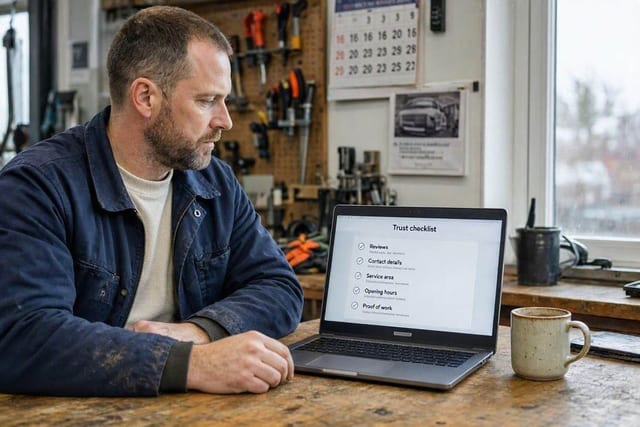
The trust signals every Tees Valley small business website should show in 2026
A practical checklist of the trust signals your small business website should show clearly, and why each one matters to cautious local customers.
Read next