Why accurate opening hours still win local customers
Wrong opening hours cost local businesses real customers. Here is why getting them right on Google, your website and directories still matters.
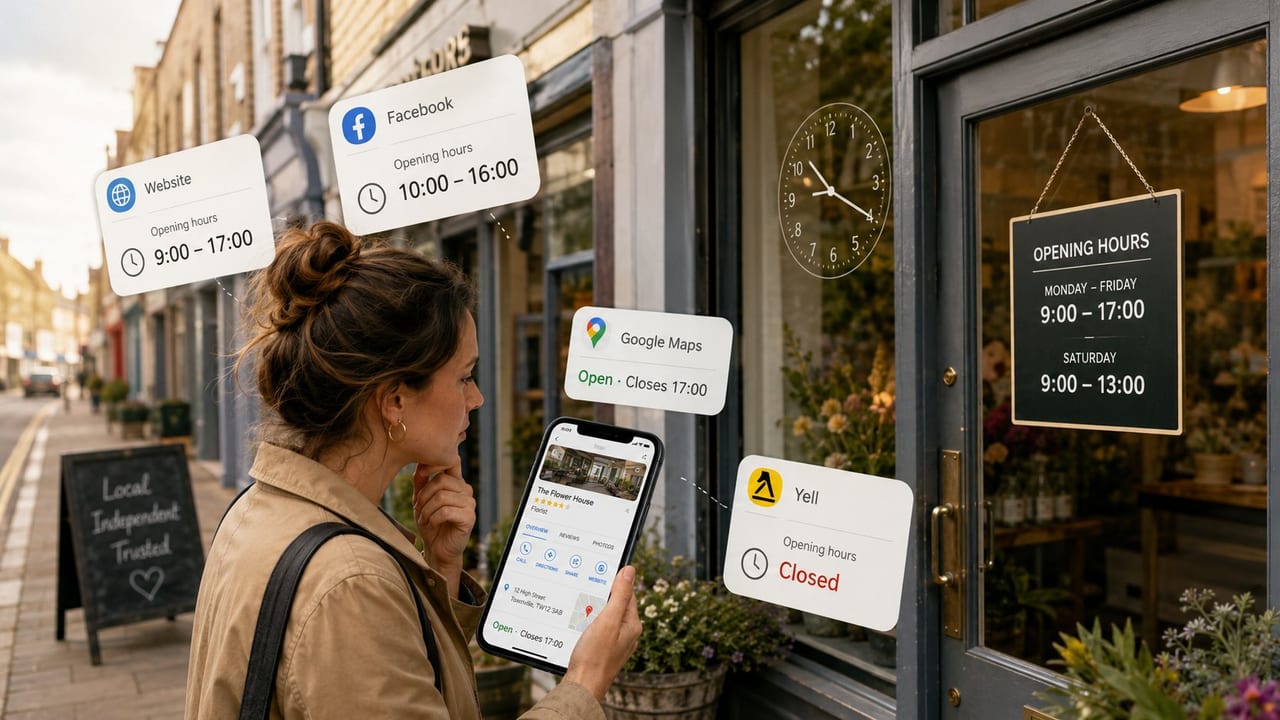
Here's a quick test. Open Google Maps on your phone and search for your own business. Are the opening hours right? Now check your website. Do they match? Now check Facebook, Yell, and any other directory listing you can find.
If they all agree, you're ahead of a lot of local businesses. If they don't, you've got a problem that's quietly sending customers to your competitors.
What to check and fix right now
Before getting into the why, here's the practical bit, because some of you will want to sort this out and get back to work.
Your Google Business Profile. Log in and confirm your hours are correct, including seasonal or bank holiday variations. Google lets you set special hours for specific dates, which is worth doing before any holiday period.
Your website. Make sure the hours match what Google shows. If they differ, customers won't know which to trust. Update both at the same time whenever your hours change.
Directory listings. Check Yell, Thomson, Bing Places, Apple Maps, Facebook, and any trade-specific directories. Old listings with outdated hours are common, especially if you changed your hours during or after the pandemic and never went back to update everywhere.
Visibility on your site. Don't bury your hours three clicks deep. They should be visible on your homepage or contact page without scrolling on a phone. If you run a shop, salon, cafe, or clinic, consider putting them in your site header or footer too.
A recurring reminder. Hours drift. Set a quarterly reminder to check them across Google, your website and your main directories. Ten minutes, four times a year.
Now, here's why all of that matters more than you'd think.
The phone screen is your new front door
Ofcom's figures show that smartphones account for 77% of UK adults' online time, and one in five online adults rely solely on a smartphone for internet access. When someone searches for a plumber in Stockton, a cafe in Middlesbrough, or a physio in Darlington, they're doing it on a small screen, usually while they're already out and deciding who to call.
Google's own UK research found that business hours were one of the most commonly searched local details, and that local searches often led to quick follow-up action. That research is older now, but smartphone use has only grown since. Opening hours, phone number, address, reviews: those are the things people look for first, and the ones they act on fastest.
Wrong hours don't just inconvenience people, they break trust
BrightLocal's trust research found that 62% of consumers would avoid a business if they found incorrect information online. Think about what that means in practice. Someone's made the effort to find you, check your reviews, and decide you're worth contacting. Then they drive over and you're closed, or they call and get no answer. That's not a design problem or a marketing problem. It feels personal. It feels like you don't care about your own front door.
I've seen this come up repeatedly in online discussions about hiring local trades and services. People remember when hours were wrong. They tell other people. And they don't come back.
Your hours are in more places than you realise
Your opening hours don't just live on your website. They appear on your Google Business Profile (which feeds Google Search, Google Maps, and AI summaries), in directory listings, on social media profiles, and anywhere else your business data has been shared or scraped. If the profile itself needs attention, use the Google Business Profile setup and maintenance guide.
Google's local-ranking guidance says complete and accurate business information improves local visibility, and that specifically includes hours. So this isn't just about customer service. Wrong hours can actually reduce how often you show up in search results.
The consistency problem is the sneaky one. Your website says five, Google says six, Yell says half four. Google Maps alone is used by 77% of adult smartphone users in a typical month. That's a lot of people potentially seeing the wrong time.
AI makes this worse, not better
Ofcom found that 75% of online adults read AI-generated search summaries at least sometimes. When someone asks an AI assistant "what time does [your business] close?", the answer depends on whatever data it can piece together about you.
One industry study found that business information accuracy on ChatGPT and Perplexity was around 68%, compared to 100% on Gemini (which pulls from Google Maps). That's early research and the numbers will shift, but the direction is obvious: if your information is inconsistent across platforms, AI systems are more likely to get it wrong. The businesses with clean, consistent data are the ones that get represented accurately.
It's really a signal of how well you run things
Accurate hours on their own aren't exciting. But they're part of a bigger picture. When a customer sees correct hours alongside a verified Google listing, recent reviews, and a website that matches what Google shows, it all adds up to a business that looks like it's paying attention. Google's guidance highlights hours, contact details, categories, reviews and photos as the details that help a business stand out in local search. Nielsen Norman Group's trust research says the same thing from the customer's side: current content and up-front disclosure improve how trustworthy a site feels.
For trades and service businesses across Tees Valley, where most firms are micro-businesses competing on trust rather than brand scale, this matters especially. By the time someone is checking your hours, they're already considering hiring you. Get the details wrong at that stage and you lose someone who was nearly yours.
Ten minutes, real money
Getting your hours right everywhere costs almost nothing and takes very little time. But it removes a barrier between you and your next customer. In a region where most businesses are small and every enquiry counts, that can matter more than most marketing spend. It is also one of the practical checks covered in the Get Found overview.
Related posts
Your Google Business Profile: What It Is, How to Set It Up, and How to Keep It Working
A plain-English guide to claiming, verifying and maintaining a Google Business Profile, with current advice on local visibility, reviews and outside help.
Read next