Why Small Businesses in the North East Don't Have Websites - And Why It's Costing Everyone
Rogue traders thrive on social media. Lloyds Bank data shows 68% of fraud starts on Meta. Yet official UK guidance still treats Facebook as a valid substitute for a business website. Here is the full picture.
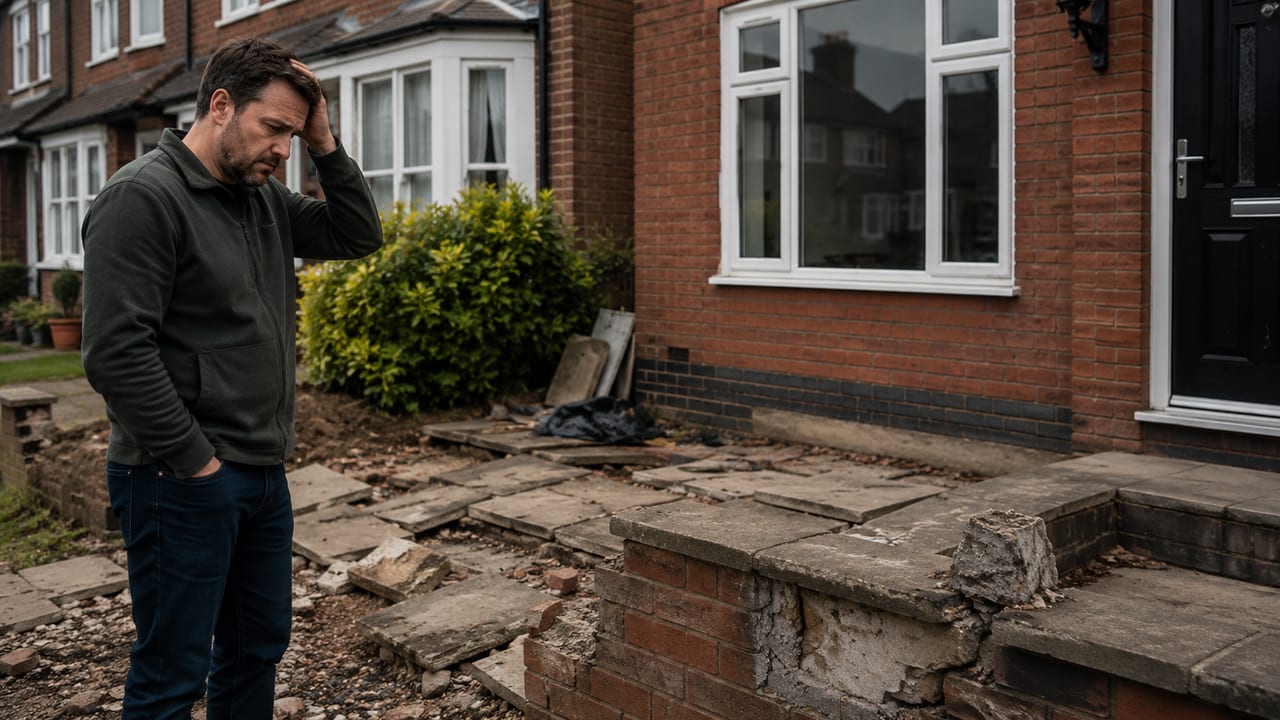
Rogue traders thrive on social media. Official guidance leaves small businesses without a website. And consumers are paying the price in the North East and beyond.
A cowboy builder found on Facebook: a story that shouldn't keep happening
A woman in the North East recently hired a local trader to carry out work on her home. She had a name, a mobile number, and a Checkatrade listing. She took a chance. The work was catastrophic. Rubbish was dumped on her lawn. Tools were stolen. The bill to repair the damage: £20,000. When she tried to pursue it, they were gone. Change a number, change a listing, start again.
This isn't just one woman's nightmare. It is a structural problem, and it is made worse by the near-total absence of a proper online presence for a huge proportion of small traders and micro-businesses across the North East.
Consumer magazine Which? has documented the same pattern repeatedly. In one case, Briony hired a trader she found on a local Facebook community page to build an outdoor cat enclosure. She paid a £1,050 deposit. Three months later, he had completed two hours of work. The frame he built was later declared structurally unsafe. He refused to refund her. After investigating further, she found a long trail of other victims he had scammed the same way. As Which? make clear in their guidance on finding reputable traders: avoid traders who cannot provide a contract, a website, or references. A Facebook page alone is not sufficient.
The question this piece asks is: how did we get here, and whose job is it to fix it?
Social media fraud: the platform where rogue traders operate
Before examining the guidance gap, it helps to be clear how serious the problem of social-media-only business presence has become from a consumer safety perspective.
In June 2026, Lloyds Bank published analysis drawn from fraud reports made by more than 25 million of its retail customers. The finding was stark: 68% of all purchase fraud reports originated on Meta-owned platforms - specifically Facebook, Instagram and WhatsApp. Customers reported losing an estimated £66 million a year to scams originating on those platforms, more than double the £27 million figure recorded in 2023. Lloyds fraud prevention director Liz Ziegler, writing in the Sunday Times, described the human cost plainly: "Customers tell us they feel upset, embarrassed and shaken. This is deeply personal and it can take a long time to recover."
Lloyds is not alone in raising this alarm. TSB Bank has separately reported that 80% of losses across its three biggest fraud categories originated on Meta platforms.
This is the environment in which a local trader operating solely through a Facebook page is asking potential customers to trust them. They share the same platform, and the same visual vocabulary, as fraudsters running sophisticated scams at industrial scale. The legitimate sole trader with no website is indistinguishable, at first glance, from the person who will take a deposit and disappear.
Cheshire West and Chester Council's Trading Standards team put it directly in an official public warning: "The use of an online messaging app or social media platform as the only method of contacting a trader is a real red flag. Many rogue tradespeople rely on being able to disappear after securing large sums of money from their victims, who then have no way of tracing them." Their Cabinet Member for Homes, Planning and Safer Communities added: "A builder being 'instantly available' to do work on your home after a conversation on Facebook is a real warning sign."
A Trading Standards body, funded by public money, is warning consumers that the digital presence used by the majority of North East micro-businesses is a red flag for fraud. That is a serious indictment of the status quo.
Do small businesses in the UK have to have a website? No - and that's the problem
For years, the conventional wisdom in business start-up advice was clear: if you're launching a business, you need a website. It was treated as a near-legal baseline, the digital equivalent of having your name above the door.
It was never actually a legal requirement.
There is no UK law requiring any business to have a website. Not for sole traders, not for partnerships, not even for limited companies - though limited companies do have legal disclosure obligations if they operate a site. For the vast majority of local traders, what the law requires is simple: register as self-employed with HMRC and file an annual self-assessment tax return. That is it.
What the law does govern is what must appear on a website if you choose to have one. For sole traders and partnerships, that amounts to a business name, contact details, and a VAT number if applicable. There is no legal compulsion to build one in the first place.
So the assumption that small businesses were being told to get a website as part of starting up was always guidance, not law. And as we'll see, even that guidance has weakened.
What UK start-up guidance actually says about websites
GOV.UK and the Business Growth Service
The government launched its Business Growth Service in July 2025, positioning it as a single point of entry for businesses looking to start, scale and succeed. It is a clear improvement on what came before in terms of consolidating advice. But when you examine what is actually covered at start-up stage, the focus is on tax compliance, legal structure, business planning and funding access. A website appears, if at all, as one marketing option among several - not as a credibility baseline.
Third-party start-up checklists that reference GOV.UK guidance do mention online presence, but in ways that reveal the problem rather than solve it. One widely-used resource describes establishing an online presence as meaning "build a website, optimise for SEO, and create a marketing plan using digital strategies such as social media, email marketing, and local business listings." That bundles a website together with social media as interchangeable tools. Another simply states: "create a company website and be active on social media platforms." As if those two things are equivalent. They are not.
The King's Trust Enterprise Programme
The King's Trust Enterprise Programme covers business planning, marketing, sales, budgeting and tax for young entrepreneurs aged 18 to 30. The marketing component is broad enough to include digital channels. But there is no specific guidance that a website is a non-negotiable starting point for credibility. The framing is "marketing," which participants interpret however they choose - and in 2026, that often means a social media page.
NBSL and the North East Business Support Fund
NBSL, the North East Business and Enterprise Support Agency, is one of the longest-established support organisations in the region. They do include web design as an eligible funded cost, explicitly listing "marketing and web design" among project types. The North of Tyne strand of their funding has been extended until December 2026, with project values between £3,000 and £8,000 qualifying for support.
This funding exists and is available. Most small businesses in the North East do not know about it.
The deeper issue is that it is positioned as a growth tool for businesses already trading - not as a foundational requirement embedded in the start-up journey. The person who just registered as a sole trader and created a Facebook page is not being told, at that moment, that funded support to build a proper website exists.
North East business support: what the TVCA and local authorities provide
Tees Valley Combined Authority
The TVCA has more digital-focused provision than might be expected, but it shows the same structural bias: growth support rather than foundational guidance.
The Tees Valley Digital Transformation programme offers one-to-one mentoring, workshops on eCommerce, website development, social media, digital marketing and cyber security, plus grants of up to £3,000. It is described as open to sole traders. But places are limited, access requires completing a questionnaire and application, and for someone already anxious about technology, that barrier is real.
In January 2026 the TVCA separately awarded a contract worth over £127,000 for a "Digital Marketing Transformer" programme specifically for micro visitor economy businesses. This is telling: the authority clearly recognises a problem with micro-business digital presence. But the response is a contracted programme delivered after the fact - not guidance embedded at the point of business formation.
Website funding in the Tees Valley is also available through match-funded consultancy programmes. The consistent caveat: funding approval must be in place before work starts, which requires knowing the funding exists.
Local authorities across the North East
Across the region, council start-up pages follow a consistent pattern: signposting to other bodies rather than providing direct guidance on digital presence.
- Middlesbrough Council points to GOV.UK and to Enterprise Made Simple for guidance. No mention of websites on the start-a-business page.
- Newcastle City Council highlights the North East Growth Hub and the Business and IP Centre at Newcastle City Library. Digital presence is not called out specifically.
- Sunderland City Council offers the Enterprising Sunderland programme covering business fundamentals, employment law and consumer rights. Nothing on web presence.
- County Durham provides Business Durham with funding signposting and innovation support. Website design appears as a service you can hire locally, not as something you are advised you need.
- North East BIC provides fully funded support to early-stage businesses across the region. Enterprise broadly - a website is not flagged as a baseline requirement.
These bodies do good and often excellent work. The problem is not what they do. It is what nobody addresses at any point in the chain.
Why a Facebook page is not a website: the evidence
Not everyone uses social media
Many people actively refuse it: on principle, for mental health reasons, due to digital literacy gaps, or simply because they do not want to. A business that exists only on Facebook or Instagram has already excluded a meaningful portion of potential customers before a word has been exchanged.
Organic reach on social media has collapsed
Facebook page posts now reach, on average, between 1.37% and 5.9% of followers - down from around 16% in 2012. Some studies record engagement as low as 0.07% for business pages. A page with 1,000 followers might organically reach fewer than 15 people per post. Instagram figures are similar, with average brand reach measured at around 4% per post in 2024. The platforms have converted free organic reach into a paid product. Businesses relying on social media visibility are, in most cases, already invisible unless they are paying for promotion.
You do not own your social media audience
A website is owned property. A Facebook page is a tenancy. The landlord changes the rules at will. Algorithm updates, account suspensions, policy changes or platform decline can erase years of built-up presence overnight. This is not theoretical: 40% of businesses reportedly saw significant traffic loss when Facebook changed its algorithm in 2023.
Social media does not answer the Google question
When someone receives a word-of-mouth recommendation for a local trader, the first thing they do is search for that business. Not on Facebook. On Google. No website means no result, or a result that finds nothing. That absence registers as a warning sign. Research shows 97% of consumers search online for local businesses before engaging. 30% will not even consider using a business without a website. 84% rate a business with a website as more credible than one relying on social media alone.
Word of mouth cuts both ways
It generates work brilliantly until it doesn't. A recommendation becomes an anti-advertisement the moment the work is poor. When that happens, a business with no reviews trail, no fixed address and no verifiable online history has nothing to counteract it - and no platform to respond through.
Why legitimate small businesses suffer when rogue traders share their space
This is where the threads of the argument converge.
Lloyds Bank data shows that two in three purchase fraud reports now originate on Meta platforms, costing UK consumers £66 million a year and rising sharply. Trading Standards officers across the country are actively warning consumers that a social-media-only presence is a red flag for rogue traders. Which? is documenting repeated cases of homeowners fleeced by builders and contractors found on Facebook.
And yet small business guidance - from GOV.UK down to local council start-up pages - continues to treat a Facebook page and a business website as broadly interchangeable options.
The damage extends well beyond the defrauded consumer. It falls on every legitimate local trader operating in the same space. When the cautious consumer learns to treat a social-media-only presence with suspicion, the honest window cleaner, the reliable landscaper and the skilled joiner all pay the price alongside the fraudster. They are operating in the same digital environment with nothing visible to distinguish them.
A business with a proper website, a verifiable address, a consistent reviews trail and a professional online presence is leaving evidence of legitimacy at every step. That does not guarantee quality. But it creates accountability, makes disappearing harder and gives consumers something to check before they hand over money.
When consumers lose confidence in unverifiable local traders, local money migrates to national chains and platforms that carry brand guarantees. The local economy loses out twice: once to the fraudster, and once to the national brand that picked up the business the legitimate local trader should have won.
Website accessibility: a legal obligation that is not being met
One further issue sits under all of this: accessibility.
The UK Equality Act 2010 requires all service providers - public and private - to make reasonable adjustments to ensure people with disabilities can access their services, including digital services. In principle, business websites must be accessible to people with visual, hearing, motor and cognitive impairments.
In practice there is a two-tier reality. Public sector organisations face enforceable requirements under the Public Sector Bodies Accessibility Regulations 2018, requiring compliance with WCAG 2.2 AA standards. The Equality and Human Rights Commission can investigate and enforce.
For private sector businesses, the obligation exists but enforcement is near non-existent. No UK private organisation has been successfully taken to court solely on grounds of website inaccessibility. The "reasonable adjustments" standard is vague enough that most businesses argue they are unaware of, or not proportionately responsible for, full compliance.
This matters here for two reasons. First, many small business websites that do exist are failing basic accessibility standards, excluding older and disabled users who are often precisely the customers local trades serve. Second, it is another area where guidance is available but never embedded: businesses building their first website receive no automatic steer toward accessible design and often work with agencies that have never run an accessibility audit.
From June 2025, the European Accessibility Act applies to businesses selling goods or services to EU customers, aligning with WCAG 2.2 AA. For domestic UK businesses, the Equality Act obligation remains in place. It is simply not being enforced.
Get found. Get trusted. Get chosen.
The principles of a sound local digital presence are straightforward. A business needs to be found by people who are looking, trusted by people who find it, and chosen over the alternatives.
Every failure discussed in this piece undermines one or more of those three things:
- No website means not being found when a potential customer Googles a recommendation.
- Social media only means weak or no trust signals, a presence that can be erased overnight, and a platform that Lloyds Bank's own data links to the majority of UK purchase fraud.
- No reviews trail, no verifiable address and no stable online identity means no credible basis to be chosen over any alternative, legitimate or otherwise.
The infrastructure to address this already exists in the North East. NBSL has grant funding for web design. The TVCA's Digital Transformation programme offers mentoring and grants. The North East BIC provides free support to new businesses. Business Durham, Enterprise Made Simple and the Growth Hub all have resources that could help.
None of it is joined up at the moment that matters most: when someone registers as a sole trader and makes their first decision about how to present themselves to the world.
What needs to change
This is not a critique of individual bodies doing useful work. The problem is systemic, sitting in the architecture of how start-up guidance is designed and delivered.
1. A website should be a standard element of start-up advice, not a growth-stage upgrade. Every start-up workshop, one-to-one advisory session and online checklist should treat a basic website the same way it treats a business bank account: something you set up at the beginning, not something you revisit later.
2. Micro-grant funding for web presence should be available from day one. The NBSL model is good, but a small, accessible grant available at the point of HMRC registration - specifically for basic web presence - would reach the people who currently fall through the gap.
3. Local authority start-a-business pages need to include specific guidance on digital presence, not just signposts to other bodies. A page that explains VAT registration but says nothing about why you need a findable, verifiable online presence is giving dangerously incomplete advice.
4. Accessibility should be embedded in any publicly funded web support. If grant money is helping local businesses build websites, those websites should meet basic accessibility standards from day one.
5. Consumer education is part of the solution. Lloyds Bank, Trading Standards and Which? are all now on record warning people about the risks of hiring tradespeople with no verifiable web presence. That message needs to reach consumers at a local level, not just in national press. Informed consumers demand better, and that demand creates the market incentive for better practice.
Summary: the digital credibility gap is a local economy problem
The North East has a real and measurable problem with small business digital presence. The causes are understandable: technology anxiety, bad experiences with overpriced agencies, guidance that treated social media as a good-enough alternative, and the absence of any legal requirement that might have forced the issue.
The consequences are not abstract:
- A woman facing a £20,000 repair bill from a trader with no verifiable online presence.
- £66 million a year lost by UK consumers to fraud originating on the very platforms being used as a substitute for business websites.
- Legitimate local traders losing work because they are indistinguishable from fraudsters in the same Facebook groups.
- Local spending migrating to national brands that offer the trust signals local businesses are not providing.
The support infrastructure already exists in this region. The will to move it to the front of the queue - to treat web presence as a foundation rather than a growth option - is what's missing.
That needs to change.
References and further reading
- GOV.UK Business Growth Service - national start-up support and guidance
- NBSL North East Business Support - grants including web design for North East SMEs
- North East Growth Hub - regional business support directory
- Tees Valley Combined Authority Business Support - TVCA programmes and funding
- Tees Valley Digital Transformation Programme - mentoring, workshops and up to £3,000 grant
- North East BIC - Starting Your Business - fully funded regional support
- Middlesbrough Council - Start a Business - local authority guidance
- NEBSF Web Design Funding (North of Tyne) - practical overview of available web grants
- Website Funding North East - Tees Valley and wider NE website funding guide
- UK Website Legal Requirements 2026 - HWB Accountants - what businesses must display if they have a website
- UK Web Accessibility Law - Siteimprove - overview of the Equality Act and public sector regulations
- Equality Act 2010 and Website Accessibility - Level Access - private sector obligations explained
- Small Business Website Statistics 2026 - Rudys.AI - data on website impact on revenue and trust
- Facebook Organic Reach Decline - Campaign Pros - the collapse of free social media reach
- The Decline of Organic Reach 2026 - Addictive Digital - current reach figures across all major platforms
- The King's Trust Enterprise Programme - start-up support for 18-30 year olds
- FSB Small Business News - North East - regional digital adoption news and programmes
- Lloyds Bank: 68% of fraud starts on Meta - Yahoo Finance - bank data on platform-originated fraud, June 2026
- Cheshire West Trading Standards: Cowboy Builders Using Social Media - official council warning on social-media-only traders
- Which?: I Was Fleeced by a Rogue Builder I Found on Facebook - consumer case study and advice on finding reputable traders
Related posts
The Implementation Gap Facing Small Businesses in Tees Valley
Some of the best tradespeople and local businesses in Tees Valley are still surprisingly hard to find online.
Read nextGive customers enough evidence to trust the business
See the credibility details customers look for when a social profile or recommendation is not enough on its own.
See what helps customers trust you