The trust signals every Tees Valley small business website should show in 2026
A practical checklist of the trust signals your small business website should show clearly, and why each one matters to cautious local customers.
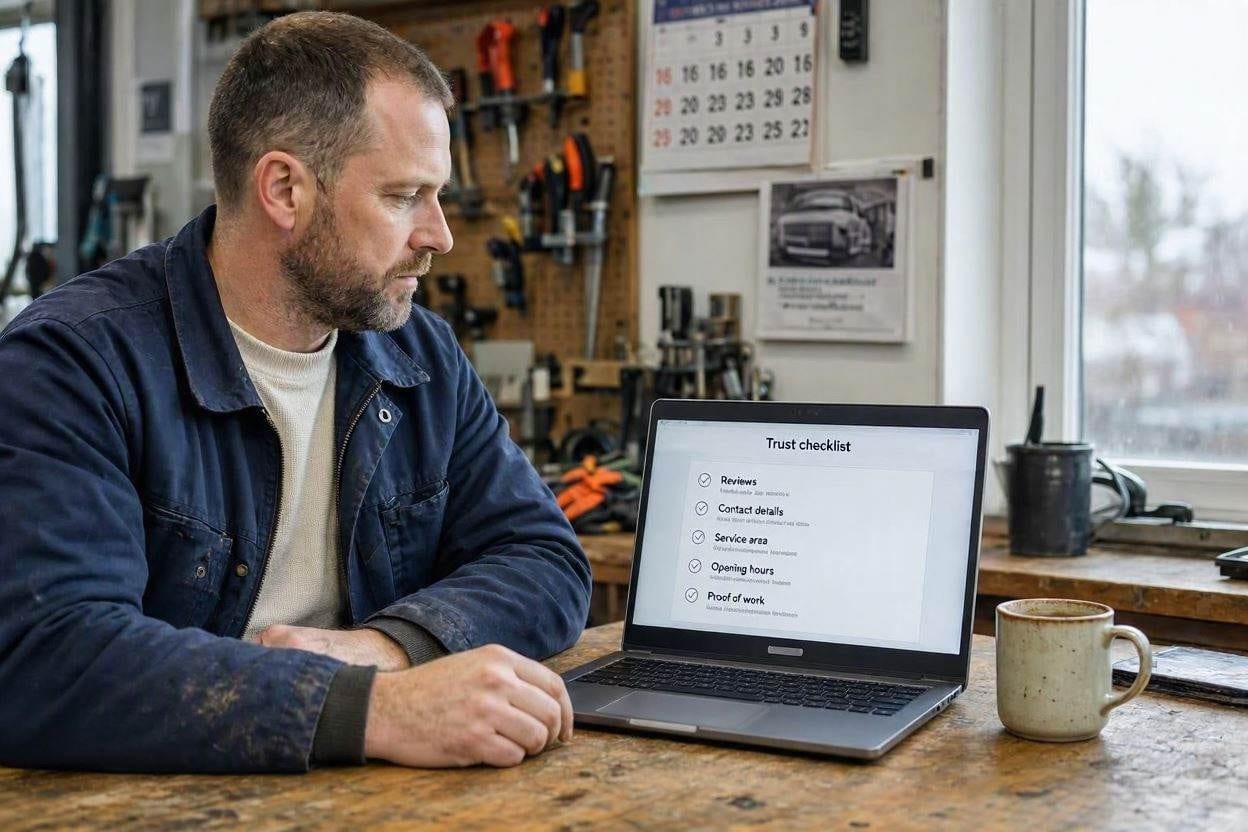
Most customers aren't looking for the flashiest website. They're looking for the one that makes them feel most comfortable getting in touch.
That might sound obvious, but plenty of local business websites still miss the basics. Not because the business is bad, but because nobody ever spelled out what cautious customers actually check before they phone or fill in a form.
This post is a practical checklist. Cover these things clearly and you're ahead of most local competitors. Miss them and you're probably losing enquiries without knowing it.
Why trust matters more than design
Nielsen Norman Group's research into web trustworthiness found that design quality, up-front disclosure, comprehensive and current content, and visible links to the wider web all improve how trustworthy a site feels. That research gets cited a lot because it matches what most of us already sense: a site that looks cared-for and gives you the information you need feels more reliable than one that doesn't.
BrightLocal's trust research backs this up from a local business angle. Their findings show that business websites are among the most trusted sources people use when researching a local business, and that many customers visit the website after reading positive reviews. The website isn't usually where discovery starts, but it's often where the decision gets made.
For Tees Valley specifically, this matters because the region is dominated by micro-firms. Nomis data shows 88.1% of the area's 17,705 enterprises have fewer than ten employees. These aren't businesses with marketing departments. Most are owner-managed, which means the website has to do a lot of the trust-building work on its own.
Contact details that are easy to find
This sounds basic, and it is. It's also the one that gets missed most often.
Your phone number, email address, and physical location (or service area) should be visible without scrolling on your homepage, and definitely on your contact page. If someone has to hunt for how to reach you, that creates friction. For a cautious customer comparing three or four businesses, friction is often enough to make them try the next one instead.
One in five online adults rely solely on a smartphone for internet access. On a phone screen, buried contact details are even harder to find. If your number isn't tappable and your email isn't obvious, you're making it harder than it needs to be.
A clear explanation of what you actually do
A lot of local business websites assume the visitor already knows what the business offers. They don't. Or at least, they don't know the full picture.
If you're a joiner, do you do kitchens? Do you do shop fits? Do you work with domestic customers, commercial ones, or both? If you're an accountant, do you handle personal tax, business tax, payroll, or all three? If you're a dog groomer, what breeds do you work with and what services do you offer?
You don't need essays. You need to be specific enough that a visitor can quickly tell whether you do the thing they need. Vague service descriptions leave doubt, and doubt is what stops enquiries.
Proof that you're a real, active business
Customers have learned to be wary. They've seen enough stories about rogue traders, businesses that disappear after taking a deposit, and companies that look professional online but don't deliver. The CMA says online reviews may influence up to £23 billion of UK consumer spending annually, which gives you some sense of how seriously people take the question of whether a business can be trusted.
Your website should show visible signs that you're real and currently trading:
- Photos of your actual work, premises, or team (not just stock images)
- Recent reviews or testimonials
- Accreditations, trade body memberships, or insurance details where relevant
- A date or timestamp that shows the site has been updated recently
- An "about" section that explains who you are and where you're based
None of this needs to be elaborate. A few genuine photos and some honest words about who you are can go a long way.
Reviews and testimonials on your site
Reviews are one of the strongest trust signals a local business can show. BrightLocal's 2026 survey found that 85% of consumers are more likely to use a business after positive reviews, and that over half visit the business website afterwards. Positive reviews make people want to check you out further, and the website is often where they go next.
The important thing is that your website should reflect what your reviews say. If someone reads great things about you on Google and then lands on a website with no testimonials, no case studies, and no evidence of happy customers, there's a disconnect. The trust that reviews started needs to be continued on your site. The guide to why a website can lose leads after good reviews follows that hand-off in more detail.
You don't need dozens. A handful of genuine, specific testimonials from real customers, ideally mentioning the type of work and the area, can make a real difference.
Consistency with your Google Business Profile
This one catches a lot of businesses out. Your Google Business Profile shows your name, address, phone number, opening hours, services and photos. Your website should match all of those details exactly.
If your Google listing says you're open until six but your website says five, that creates doubt. If your profile lists services that your website doesn't mention, or your website shows a different phone number, customers start to wonder which version is right. Google's own guidance says that complete and accurate information improves local visibility, so consistency isn't just about customer trust. It directly affects whether you show up in local search.
Current content, not a frozen site
A website that looks like it hasn't been touched in three years sends a specific message: this business might not still be active, or at least it doesn't care much about its online presence. That might be unfair, especially if you're flat out with work, but it's how many customers will read it.
You don't need to blog every week or constantly redesign. But your site should feel current. Update your service descriptions when your offering changes. Add new photos of recent work. Make sure seasonal information like holiday hours is correct.
Local proof
For a business serving Tees Valley, showing that you're genuinely local matters. Customers searching for a service in Middlesbrough, Stockton, Hartlepool, Darlington or Redcar want to know you actually work in their area, not that you're a national company pretending to be local.
Mention the areas you cover. Show photos from local jobs. Reference local contexts where it's natural to do so. Include a clear service area description. This kind of local proof also helps search engines understand where your business operates, which feeds into local search visibility.
The checklist
Quick reference. Your website should show:
- Phone number and email, easy to find on every page
- What you do, described specifically enough to answer "do they do the thing I need?"
- Where you work, with areas or postcodes mentioned
- Opening hours that match your Google Business Profile
- Photos of real work, real people, or real premises
- Reviews or testimonials from actual customers
- Who you are, with enough background to feel genuine
- Signs the site is current and maintained
None of these are expensive or complicated. Most don't need a web developer. They just need someone to look at the site through a customer's eyes and ask: would I trust this business enough to get in touch? The Get Trusted overview brings those checks together around the customer's decision.
Related posts

Why your website loses leads after good reviews
Good reviews get people interested. If your website doesn't keep that trust going, they leave before they ever contact you.
Read next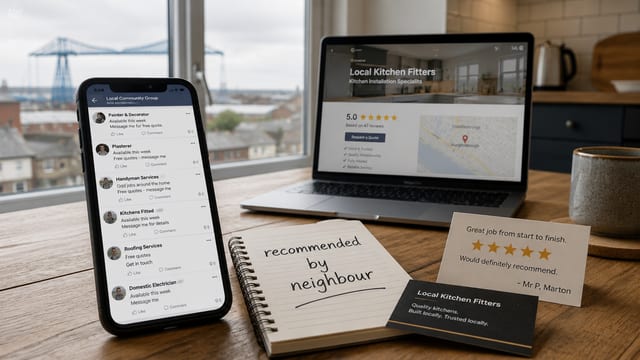
Why Facebook Group Posts Often Don’t Bring Work
Many small business owners post in local Facebook groups, hoping to attract new customers.
Read next