Local SEO is not dead, but AI has changed the hand-off
AI hasn't replaced local SEO. But it has changed how customers move from search results to your website, and what they expect to find when they get there.
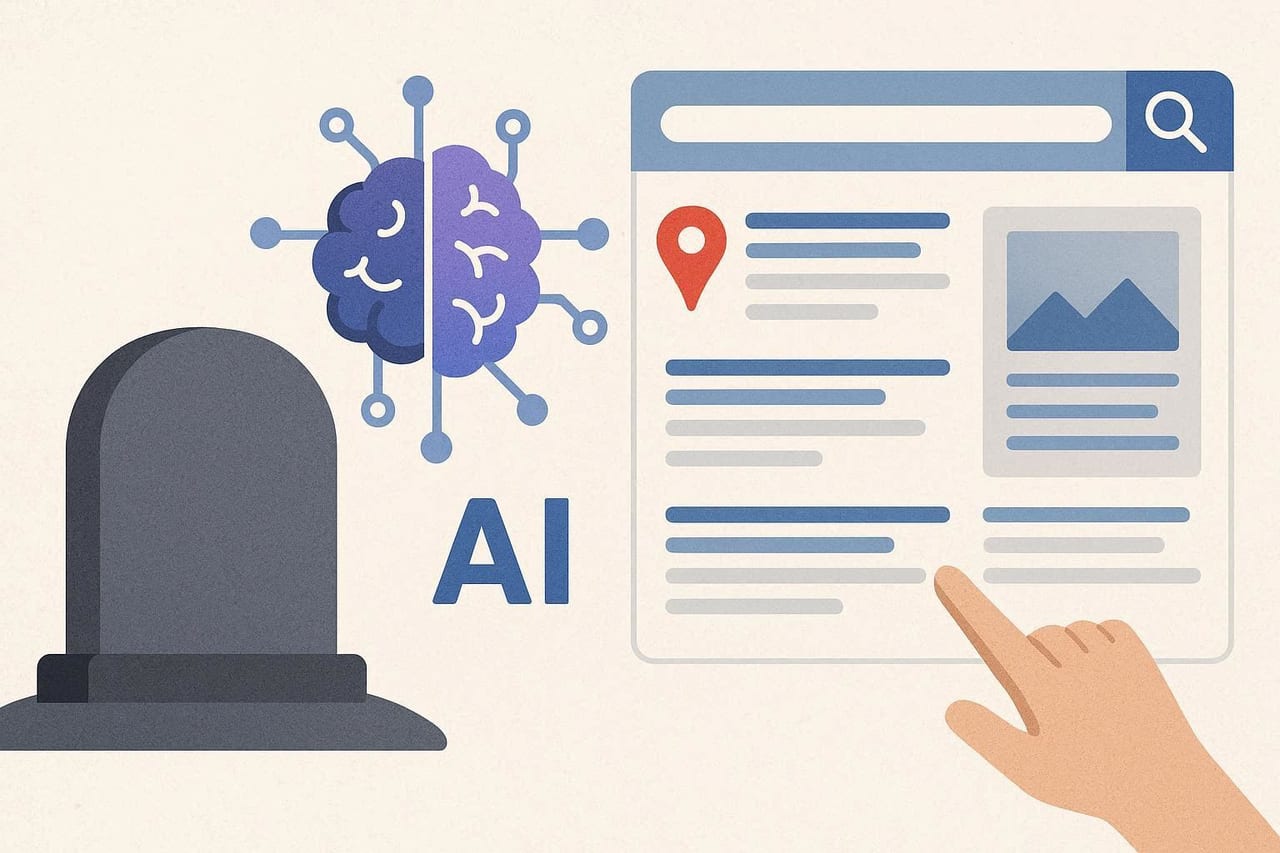
I was having a look through my inbox the other morning, filtering out the usual clutter, and I noticed a sudden spike in rather frantic subject lines. Apparently, search engine optimisation is dead again. Or, if you believe the latest round of cold pitches, AI has entirely swallowed Google whole, and local businesses must buy a brand-new, ground-up strategy immediately or vanish.
It made me wonder why we love a crisis so much.
The shift in how people find us is real enough, but I suspect it is far less of an apocalypse and much more of a quiet detour. The road we are driving down is exactly the same; it is just that the signposts have been painted a slightly different colour. The foundations remain untouched.
The basics still matter (Google says so)
Google's own guidance is unusually clear on this point. AI Overviews and AI Mode draw on Google's existing Search systems and indexed content, and they show links to supporting pages. That is about it.
Google says there is no separate technical requirement or special markup for appearing in these features. We do not need obscure code, weird formatting, or any of the pricey "AI optimisation" hacks popping up in our inboxes. The useful work is still helpful content, a clean technical setup, and accurate business data.
Not long ago, someone messaged me directly on LinkedIn asking about optimising for AI. Their Google Business Profile didn't show any opening hours or even a phone number, but they still wanted to look at the AI angle first.
I often find myself looking back at the Google Business Profile, the website content, and the reviews. These have always done the heavy lifting. They still do. They tell Google who we are, what we offer, and where we operate. That foundation remains rock solid. The review process starts with those basics.
What has changed is the journey
The real shake-up seems to be happening earlier in the story, long before a finger actually hovers over a mouse link.
Ofcom's 2026 research reports that 54% of UK adults use tools such as ChatGPT, Copilot or Gemini. That is a real shift in daily habits, even if it does not tell us exactly how each local customer will search.
I try to picture a customer looking for services. Before they ever touch a homepage, they might read a quick AI summary of a business, spot a bullet point pulled from a Google profile, or get a direct recommendation from an assistant. The old hand-off is different. In the past, a website acted like that first, slightly nervous handshake. Now, I suspect it plays a different part, behaving more like the quiet nod of agreement at the very end of a meeting.
It feels as though the website has a new job. It has to stop trying to make a loud first impression, and instead focus on proving that the AI summary was accurate about you. Say an AI told a user that you offer a particular service in their town. When that user clicks through, your site must confirm it straight away. Don't make them search for proof. Show it immediately.
AI answers still need checking
Here is where things get interesting. And perhaps a little challenging.
An assistant can produce a recommendation or summary, but that does not make every detail current. A customer still needs somewhere reliable to check what a business does, where it works and how to contact it.
When I was first building some of the tools at Local Roots Digital, an AI agent kept giving me different answers about how many directories a business appeared in. I had to cross-check it with a third-party checker to make sure the result was accurate. Newer models have improved, but I still check the underlying data.
That is why mismatched hours, phone numbers and addresses are worth taking seriously. If your Google listing says you shut at 5 PM but your website says you are open until 6, a customer has to guess which one is true. The same problem is covered in more practical detail in why your Google profile and website must tell the same story.
What agencies are actually selling
If an agency approaches you promising "AI search optimisation" or "GEO" (generative engine optimisation), it is worth taking a breath. We should know what we are actually buying.
The local SEO market has not shifted nearly as much as the marketing pitches suggest. Look at any agency directory. You'll see the exact same core services they've sold for a decade: Google Business Profile work, technical SEO, content writing, and monthly reports. It's the same engine.
It seems to me that agencies are mostly just taking the exact same service they sold you in 2018 and wrapping it in some crisp, futuristic-looking foil. I don't think it is necessarily a scam, but it does get confusing if we believe we are investing in some revolutionary, futuristic technology.
Google's Search Central guidance says the same thing more plainly: the usual SEO best practices still apply to its AI features.
I've always believed in keeping things simple. If you are going to hire an agency, find the person who can sit down over a cup of tea and explain, without a single syllable of corporate jargon, exactly what they are doing to get you found and how they'll prove it's working. If they can't explain it without using buzzwords, it's usually best to walk away.
What should your business actually do?
Google includes traffic from its AI features within Search Console's overall Web reporting, rather than providing a separate AI-visibility report. That still gives you a sensible place to watch what happens to search impressions and clicks over time.
For a business operating in the Tees Valley or across the wider North East, you don't need a massive budget or a complex new strategy. The practical steps are straightforward.
First, keep your Google Business Profile complete and accurate. The hours you open, the exact list of things you do, and your phone number are the practical details customers look for.
Second, match your website to your profile. You can't have conflicting stories online. If your Google map listing says you shut the doors at 5 PM but your contact page claims you're open until 6, you are giving customers a reason to hesitate.
Third, nail the technical basics. Is your site painfully slow, or does it load in a snap? Does the text resize properly when you open it on a cheap smartphone? Can search engines navigate through your pages without hitting a dead end? Readable reflow matters for people who need to enlarge text as well as for ordinary phone use.
Fourth, write clear, dedicated service pages. Resist the urge to dump every single thing you do onto one giant, scrolling homepage. If you offer several distinct services, give each of them its own dedicated page. Write down exactly what the service involves and the specific towns you cover, which helps both the search crawlers and a real customer understand what you do within a few seconds of landing.
Finally, stay on top of reviews. Ask for genuine feedback and reply where a response is useful. Recent reviews help a customer see that a business is active, while a helpful response shows that somebody is paying attention.
One thing I notice when reading reviews is how often they sit at one extreme or the other: either hugely congratulatory or downright rude. I don't mean reviews of my own work, but reviews across plenty of other businesses.
And please, ignore the self-proclaimed gurus offering shortcuts. Google has said repeatedly that they aren't hiding any secret entrance criteria for AI search. In the long run, the businesses that get recommended are going to be the ones with the cleanest, most trustworthy facts scattered across the web. It won't be the companies spending hundreds of pounds trying to outsmart a system that updates its rules every single Tuesday.
The honest picture
AI search is here, and it is growing. But for most local businesses, I don't think the right response is to panic or buy a shiny new marketing package. It is simply about doing the basics a bit better. Being accurate. Keeping your site clear. Making sure your phone number and address are written exactly the same way on every directory you can find.
The route your customers take to find you has drifted a bit. They might click through to your contact page already knowing your prices or your specialties because an AI told them. I suspect our job now is simply to make sure those details match up perfectly, so they don't get cold feet and click back to their search results. The local SEO and visibility support sets out the practical visibility checks behind that work, and Get Chosen covers what happens when they are deciding whether to contact you.
It makes me wonder what other small details we've been taking for granted that are suddenly more important than ever.
Related posts
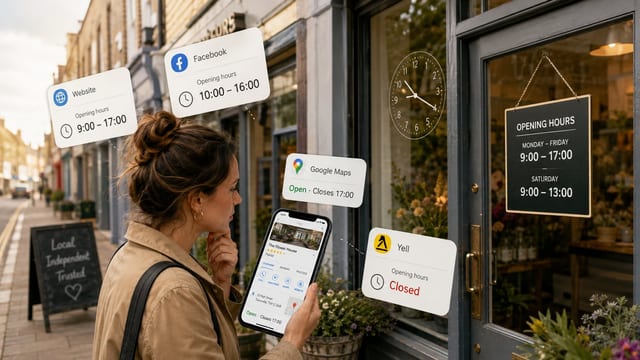
Why accurate opening hours still win local customers
Wrong opening hours cost local businesses real customers. Here is why getting them right on Google, your website and directories still matters.
Read next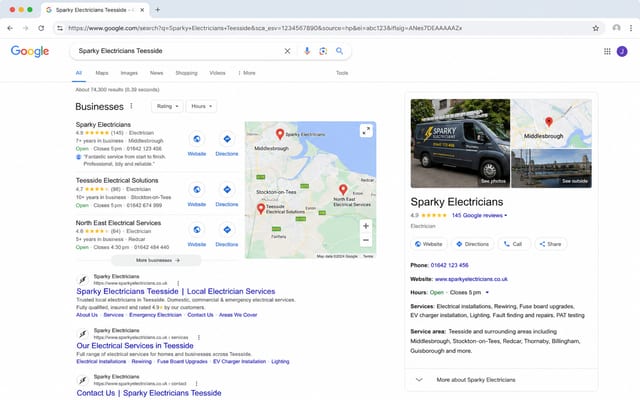
Your Google Business Profile: What It Is, How to Set It Up, and How to Keep It Working
A plain-English guide to claiming, verifying and maintaining a Google Business Profile, with current advice on local visibility, reviews and outside help.
Read next