Why GBP and your website must tell the same story
If your Google Business Profile says one thing and your website says another, customers notice. So do Google and AI systems.

Your Google Business Profile and your website are the two most important pieces of your online presence. One shows up in Google Search and Maps. The other is where customers go to learn more, check details, and decide whether to get in touch. If those two things tell different stories, you've got a problem that quietly costs you customers.
This isn't a rare issue. It's one of the most common things I see when looking at local business websites across Tees Valley. The Google listing has one phone number, the website has another. The profile lists services the website doesn't mention. The hours don't match. The business name is slightly different. Each of these on its own seems minor, but together they create a pattern that makes customers wonder which version is right.
Why the mismatch happens
Most of the time, it's not carelessness. It's just that the two things were set up at different times, often by different people, and they've drifted apart.
The Google Business Profile might have been created when the business first started, with a basic set of details that haven't been updated since. The website might have been built later, or redesigned, with slightly different service descriptions or updated contact details. Directory listings add another layer: Yell, Thomson, Facebook, Bing Places, and others might all be showing old information that was correct once but isn't anymore.
This is usually drift rather than a single mistake. The listing and the website were set up, then day-to-day work took over, and the details stopped matching.
What customers see
When a customer finds your business through Google, they usually see your Google Business Profile first: your name, address, hours, phone number, reviews, and possibly a summary of your services. If they're interested, they click through to your website for more detail.
At that point, any differences between the two become visible. If Google says you close at six but your website says five, the customer doesn't know which is right. They might call at half five and get no answer, which feels like bad service even though you were technically closed. If Google lists plumbing services but your website only talks about heating, they might wonder if the listing is accurate. If your Google profile says "Smith & Sons" but your website header says "Smith Plumbing and Heating", it looks less professional than it should.
BrightLocal's trust research found that 62% of consumers would avoid a business if they found incorrect information online. The mismatch between a Google listing and a website is a very common source of that kind of incorrect information. Customers don't usually tell you that's why they left. They just try the next business.
What Google sees
Google's own local-ranking guidance says that complete and accurate business information improves local visibility. That means the information on your Google Business Profile and your website both feed into how Google decides whether and where to show your business in local search results.
When those two sources disagree, it creates ambiguity for Google's systems. Which phone number is right? Which hours are correct? Does this business offer the service the customer searched for? Google's ranking systems work best when the signals are consistent and reinforcing, not when they contradict each other.
Industry consensus among local search practitioners is that NAP consistency (name, address, phone number matching across all platforms) remains one of the foundational local SEO signals. It's not glamorous, but it's one of those things where getting it wrong has a measurable cost in visibility.
What AI systems see
This is the newer dimension, and it matters more each year. Ofcom found that 75% of online adults read AI-generated search summaries at least sometimes, and 54% of UK adults use AI tools. When AI systems generate answers about local businesses, they pull information from multiple sources, including Google Business Profiles, websites, directories, and review platforms.
If those sources agree, the AI is more likely to present your business accurately. If they disagree, it might show the wrong hours, the wrong services, or skip your business entirely because the conflicting data makes it hard to present confidently.
Emerging industry research found that business information accuracy on ChatGPT and Perplexity was around 68%, compared to 100% on Google's Gemini (which uses Google Maps data). That gap is partly because Gemini has direct access to Google's own verified data, while other AI systems have to piece things together from whatever they can find. The less consistent your information is across platforms, the more likely you are to be misrepresented on the AI platforms where consistency is already weaker.
What to align
The fix is straightforward. Go through your Google Business Profile and your website side by side, and make them match on these points:
Business name. Exactly the same on both. Not "Dave's Plumbing" on one and "David Thompson Plumbing & Heating Ltd" on the other.
Phone number. Same number, same format ideally. If you've changed your number at any point, check that the old one isn't still showing anywhere.
Address or service area. If you have a physical premises, both should show the same address. If you're a service-area business, both should describe the same coverage area.
Opening hours. These drift the most often. Check them on your Google profile, your website, and any other platforms. They should all match, and they should reflect your actual current hours.
Services. Your Google profile lets you list services and service categories. Your website describes your services in more detail. These should be telling the same story. If Google says you do landscaping but your website only mentions garden maintenance, either update the profile or add the detail to your site.
Photos. Your Google profile photos and your website photos should both look like the same business. This doesn't mean they need to be identical images, but they should feel consistent. A Google profile full of professional job photos next to a website with no images at all creates a disconnect.
Make it a habit, not a project
The real problem with GBP/website alignment isn't doing the initial fix. That usually takes an hour or two at most. The problem is keeping them aligned over time, because details change and it's easy to update one platform and forget the others.
Setting a quarterly reminder to check the key details across Google, your website, and your main directory listings takes about fifteen minutes and prevents the kind of slow drift that causes problems. When you change your hours, update them everywhere at the same time. When you add a new service, add it to both your website and your Google profile. Small habits prevent the mismatch from building up again.
Open your Google listing and your website side by side. Check the name, number, hours, services, and address. If anything doesn't match, fix it now. It takes less time than you'd think, and the consistency pays for itself in both trust and visibility.
Related posts

The hidden cost of outdated business information online
Old phone numbers, wrong hours and stale listings quietly lose you customers. Here's how outdated information damages trust and visibility.
Read next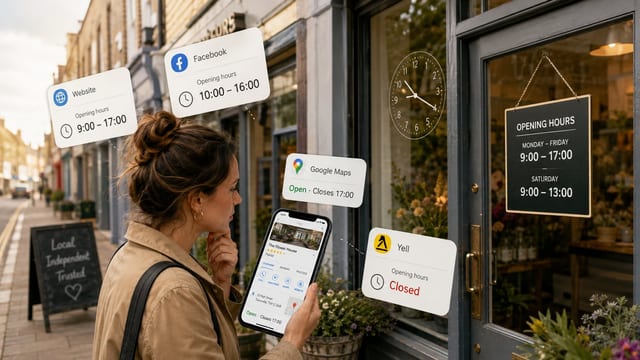
Why accurate opening hours still win local customers
Wrong opening hours cost local businesses real customers. Here is why getting them right on Google, your website and directories still matters.
Read next
What AI readiness actually means for a small local business
AI readiness for local businesses isn't about tricks or new technology. It's about clarity, accuracy and useful content, the same things that already help you rank.
Read nextSee how I help businesses get found
If Google and the website disagree on the basics, Get Found is the route for lining those details up before they cost you enquiries.
See how I help businesses get found