The hidden cost of outdated business information online
Old phone numbers, wrong hours and stale listings quietly lose you customers. Here's how outdated information damages trust and visibility.

Most local business owners don't set out to have wrong information online. It happens gradually. A phone number changes but an old directory still shows the previous one. Opening hours shift but the Google listing doesn't get updated. A website gets built, works well at first, and then sits untouched for two or three years while the business itself moves on.
None of these things feel urgent at the time. But they add up, and the cost is real even though you don't see it directly. Customers quietly leave. Enquiries don't arrive. And because the customer never tells you why they moved on, it looks like the market is just quiet when really it's your information that's pushing people away.
The problem is invisible
That's the hardest part about outdated information. It doesn't break loudly. There's no error message. Nobody phones you up to say "your hours were wrong on Google so I went to your competitor instead." They just go.
BrightLocal's trust research found that 62% of consumers would avoid a business if they found incorrect information online. Wrong information doesn't just inconvenience customers. It actively damages their confidence in your business.
For local firms in Tees Valley, where 88.1% of businesses are micro-firms and most rely on a steady stream of local enquiries, even losing a couple of potential customers a month to bad information adds up over a year.
The most common culprits
The things that go stale most often are also the things customers check most. That's the problem.
Phone numbers. If you've changed your mobile or office number at any point in the last few years, there's a good chance an old number still appears somewhere online. Directory listings, an old Facebook page, a cached Google result, a Yell listing you forgot about. When a customer calls that number and gets nothing, they don't try harder. They try someone else.
Opening hours. A lot of businesses changed their hours during or after the pandemic and never updated all the places those hours appear. Your Google listing might say one thing, your website another, and a directory listing something else entirely. Google's local-ranking guidance specifically highlights accurate hours as something that improves local visibility, so this isn't just a customer-trust issue. Wrong hours can also affect whether you show up in search results at the right time.
Service descriptions. Businesses evolve. You might have added new services, dropped old ones, or changed your focus area. If your website still describes what you did three years ago rather than what you do now, customers will either think you don't offer what they need or feel uncertain about what they're actually getting.
Address or service area. If you've moved premises or expanded your coverage area, your old address or a narrower service area might still appear in places you've forgotten about. For a trade or service business that covers a wide area, this can mean missing customers in locations you'd happily serve.
How it affects search visibility
Google's guidance on local ranking is consistent on this: complete and accurate business information improves local visibility. That means inaccurate information can actively reduce how often you appear in local search results and Google Maps.
Google Maps is used by 77% of adult smartphone users in a typical month, according to Ofcom. If your information there is out of date, you're losing visibility in one of the most heavily used local discovery tools in the country.
The effect is compounding. Wrong information reduces visibility, which reduces the number of people who find you, which means fewer enquiries, which makes it look like the problem is "marketing" when actually the problem is data.
AI search makes it worse
Ofcom found that 75% of online adults read AI-generated search summaries at least sometimes. When your hours or phone number differ from one listing to another, those summaries can show the wrong details or miss the business.
Emerging industry research found that business information accuracy on AI platforms like ChatGPT and Perplexity was around 68%, compared to 100% on Google's Gemini (which uses Google Maps data directly). That's an early finding and the field is still developing, but the direction is clear: messy or inconsistent details across different platforms puts you at greater risk of being described wrongly to customers who are increasingly using AI to find local services.
Why it is easy to let details drift
A lot of local firms set up a website and a Google listing with good intentions, then never keep them current. Cost and lack of time are the usual reasons. That matches what I see: the owner is busy running the business, so checking hours and phone numbers keeps slipping down the list.
That's understandable. But it means many local business websites and profiles are gradually drifting further from accuracy, and the longer they drift, the more trust and visibility they lose.
What to check and how often
The fix for most of this is straightforward. It doesn't need a redesign or a new marketing strategy. It needs a regular check, maybe once a quarter, to make sure the basics are still correct.
Google Business Profile. Log in and check your hours, phone number, services, address, and photos. Are they current? If you added special hours for Christmas 2024 and never removed them, sort that out. If your service list has changed, update it.
Your website. Read through your main pages as if you were a customer seeing them for the first time. Do the services match what you actually offer now? Is the phone number right? Are the hours correct? Are there any references to things that are no longer relevant?
Directory listings. Check Yell, Thomson, Bing Places, Apple Maps, Facebook, and any trade-specific directories where your business appears. Old listings with outdated details are common and easy to miss. Consistency across these matters for both customer trust and search visibility.
Social media profiles. If you have a Facebook page, Instagram account, or any other social profile, check the contact details and about sections. These often get set up once and never revisited.
The cost of doing nothing
The hidden cost of outdated information isn't a single dramatic moment. It's a steady trickle of lost opportunities. Customers who find wrong hours and give up. People who call an old number and go elsewhere. Visitors who land on a website that describes services you no longer offer and feel unsure about what you actually do.
Each one of those is a potential customer who was interested enough to look you up. That's the frustrating part: these aren't cold leads or strangers. They're people who were already partway to choosing you, and the outdated information is what stopped them.
Start with Google. Search for your own business, check the details, then check your website. If they don't match, fix them both today. Then do the same with your main directory listings. It's one of the fastest improvements a local business can make, and it often turns up things you genuinely didn't know were wrong. The Google Business Profile guide gives you a sensible starting checklist.
Related posts

Why GBP and your website must tell the same story
If your Google Business Profile says one thing and your website says another, customers notice. So do Google and AI systems.
Read next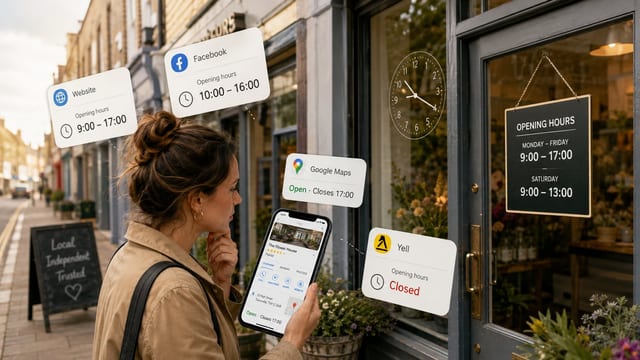
Why accurate opening hours still win local customers
Wrong opening hours cost local businesses real customers. Here is why getting them right on Google, your website and directories still matters.
Read next
What AI readiness actually means for a small local business
AI readiness for local businesses isn't about tricks or new technology. It's about clarity, accuracy and useful content, the same things that already help you rank.
Read nextSee how I help businesses get found
If old hours, numbers or listings are quietly turning people away, Get Found is the place to check what customers can actually find.
See how I help businesses get found