Why Facebook Group Posts Often Don’t Bring Work
Many small business owners post in local Facebook groups, hoping to attract new customers.
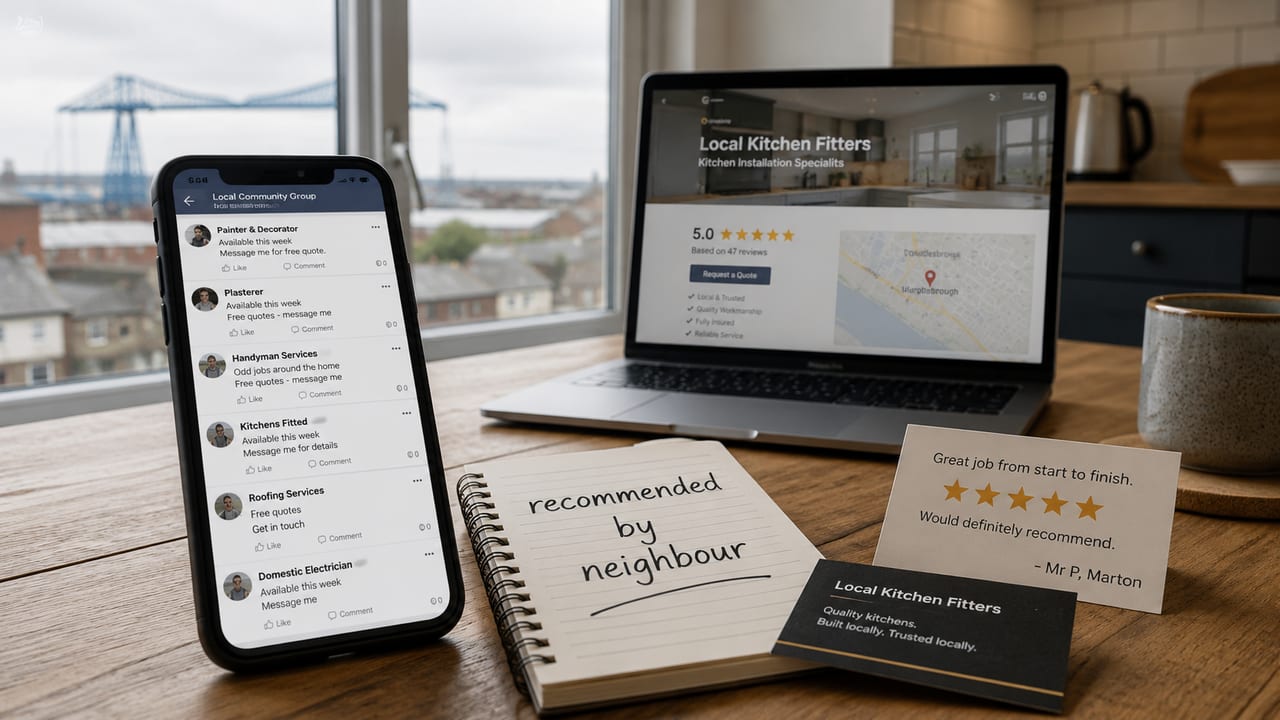
Many small business owners post in local Facebook groups, hoping to attract new customers. Yet for a lot of local businesses, those efforts just meet silence. If your posts aren't bringing in work, you're not alone. It isn't random either. There are a few clear reasons these group posts rarely turn into actual business.
I have been watching a lot of local Facebook groups recently, especially the ones used by trades and small businesses, and something keeps standing out.
Most business posts get little or no response.
It is not just my posts. It is not just one type of business either. You see plumbers, plasterers, roofers, cleaners, gardeners, dog walkers, joiners, mobile mechanics, web designers, and all sorts of local services posting away, often with very little happening afterwards.
The usual format is something like “available this week”, “message for a quote”, “all work considered”, “no job too small”, or “here is my number”. There is nothing wrong with those posts on the surface. They are simple, direct, and they tell people what is being offered. The problem is that almost everyone else is doing the same thing.
After a while, those posts all start to blend into one. A good business can end up being ignored, not because the work is poor, but because the post looks like every other advert in the group.
It is not just your posts getting ignored
I think that is where a lot of small businesses get frustrated. They post into a group, get no comments, no likes, no messages, and start wondering whether Facebook is useless, whether people are not interested, or whether they have done something wrong.
Sometimes the answer is simpler than that. People just are not using those groups in the way businesses hope they are.
A lot of Facebook groups are not really advertising spaces. They are more like the digital version of word of mouth. People often ignore a business saying “I do plastering, message me for a quote”, but they will respond to someone asking “Can anyone recommend a good plasterer?”
That second post works differently because it is not really about advertising. It is about trust.
Facebook groups work more like word of mouth
When someone asks for a recommendation, they are not just asking for a name. They are trying to avoid making an expensive mistake.
With trades especially, people are often worried about being ripped off, losing money, paying a deposit and never seeing the person again, ending up with poor work, or having to pay someone else to fix the mess afterwards. There are enough stories about rogue traders to make people cautious.
So when somebody asks “Can anyone recommend a reliable roofer?”, what they are really asking is something more like, “Who can I trust not to make this worse?”
That is why recommendations carry so much weight. If someone else says they used a business and had a good experience, it feels safer. It reduces the feeling of risk. It makes the person asking feel less like they are choosing blindly from a list of strangers.
Where do the recommendations actually come from?
The awkward part is that Facebook recommendations are not always as clean as they appear. Sometimes the replies are genuine customers who have used the business and are happy to recommend them. Sometimes they are friends or family. Sometimes they are other tradespeople doing each other a favour. Sometimes the business owner recommends themselves. Sometimes you get the classic “inbox me”, which tells you almost nothing.
That does not mean Facebook groups are useless. They can be useful, especially when someone is already asking for exactly what you do. But it does mean that posting cold adverts into groups is very different from being recommended when a customer is actively looking.
There is also another thing going on. When someone recommends a trader, the person asking feels like some of the risk has been reduced. They are not just picking a random name from an advert. They feel like someone else has already taken that risk and had a good result.
If the work turns out badly, the customer may even feel they can go back and say, “You recommended them.” That might sound slightly awkward, but it is part of why recommendations feel safer than adverts. There is a bit of social accountability attached to them.
Being noticed is not the same as being chosen
A recommendation might get your name noticed, but it does not always get you chosen.
Most people will still check you out afterwards. They might look at your Facebook page, your photos, your reviews, your website, your Google Business Profile, or simply whether you look like a real and active business. They might not spend hours researching, but they will often do enough to get a feel for whether they trust you.
This is where many local businesses lose the enquiry. Not because they were not good enough, and not necessarily because the customer was not interested, but because there was not enough trust around the business when the customer looked.
That is why I keep coming back to the same idea with Local Roots Digital: get found, get trusted, get chosen.
Getting found is only the first step. Being seen in a Facebook group, tagged in a comment, or mentioned by someone is useful, but it does not finish the job. Once somebody has seen your name, they still need to feel confident enough to contact you.
That confidence comes from small trust signals. Real photos. Clear service information. Reviews. A proper Google listing. A website that explains who you are, what you do, where you work, and how to get in touch. Recent activity. A business that looks like it exists outside of one quick Facebook post.
It does not have to be flashy. In many cases, simple is better. People are not always looking for a huge website or a clever marketing campaign. They are looking for signs that you are genuine, reliable, and worth contacting.
Talk about the customer’s problem, not just your service
Another problem with a lot of group posts is that they talk only about the business, not the customer’s problem.
For example, a post might say “professional plasterer available, free quotes”. That tells people what the business does, but it does not really put the customer in the picture. A more useful way of thinking might be, “Have you got a room you still cannot finish because the walls are cracked, uneven, or waiting for a plasterer who actually turns up?”
That is a very different type of message. It starts with the customer’s frustration rather than the service list.
The same applies to other trades. Instead of only saying “fencing and decking available”, think about the person looking at their garden fence after a windy night, wondering how long it has got left. Instead of “bathroom fitter, message for quote”, think about someone who wants the job done without weeks of chasing, mess, and half-finished work.
People are more likely to stop scrolling when they recognise their own problem. A list of services might be accurate, but a problem they already have feels relevant.
Directory sites and borrowed trust
There are also directory-style platforms that try to solve the trust problem for customers. Some traders use them because they know people are looking for reassurance before choosing someone. That makes sense. Customers want signs that a business has been checked, reviewed, or used by others.
The difficulty for small businesses is that these platforms can become another cost of being visible, and the costs are not always obvious upfront. In some cases, you have to request a quote before knowing what it might cost your business. That makes it harder to judge whether it is worth it, especially when you are already watching every pound.
This is not about saying those platforms are good or bad. It is about recognising that trust matters so much that whole platforms exist around it.
But your own online presence still matters too. A Google Business Profile, customer reviews, real photos, clear information, and a simple website all help build trust around your own business name, not just around a third-party platform.
That is important because borrowed trust only goes so far. If a customer sees your name in a Facebook group or on a directory, they may still search for you. If what they find is thin, confusing, out of date, or non-existent, that trust can fade quickly.
Facebook groups can still be useful
Facebook groups can still be part of the picture. I am not saying businesses should never use them. If they bring you work, keep using them. If people tag you when someone asks for recommendations, that is valuable. If you can join conversations in a helpful way, even better.
But relying on cold group posts alone is risky. A post disappears quickly. It gets pushed down. It competes with everyone else shouting for attention. It might be seen by people who are not looking for your service at that moment.
A stronger approach is to treat Facebook as one part of your online presence, not the whole thing.
Use groups where they make sense. Reply when people ask for recommendations. Share useful posts now and then. Show examples of work. But also make sure that when someone checks you out, there is enough there to reassure them.
Because people do check. Especially when money, homes, vehicles, pets, family, or important jobs are involved. They want to know they are not about to make a mistake.
Turn visibility into trust
That is the real issue with Facebook group posts. The problem is not always visibility. Sometimes people do see the post. The problem is that visibility on its own is not enough.
You need to be found, but you also need to be trusted. Only then are you likely to be chosen.
So if your Facebook group posts are not working, the answer might not be to post the same advert more often. It might be to step back and ask what people find when they look you up afterwards.
Do they see a business they can trust? Do they see proof of your work? Do they understand what you do and where you work? Can they contact you easily? Do they feel reassured?
If the answer is no, that is where the real opportunity is.
Not shouting louder in the group, but building something stronger around your business so that when people do hear your name, they have a reason to trust it.
Related posts

Why your website loses leads after good reviews
Good reviews get people interested. If your website doesn't keep that trust going, they leave before they ever contact you.
Read next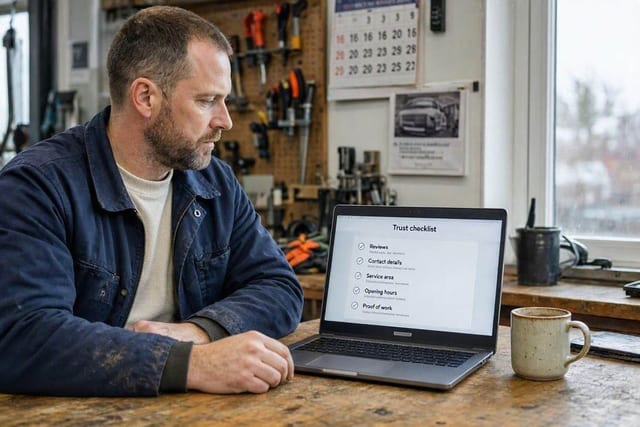
The trust signals every Tees Valley small business website should show in 2026
A practical checklist of the trust signals your small business website should show clearly, and why each one matters to cautious local customers.
Read nextHelp interested people feel sure about the business
See the proof, consistency and credibility signals customers may check after they notice your post.
See what helps customers trust you